How Business Advisors Improve Operations

Running a business today means juggling regulations, staff needs, cash flow pressures and constant demands for efficiency. Many owners feel stretched, and it becomes difficult to see where improvements should be made. A skilled business advisor brings clarity, structure and guidance that strengthens your operations and long-term stability.
Our advisors have brought together our decades of experience to help you understand the key functions of a business advisor in improving operations to help you streamline processes, improve financial visibility and make confident decisions.
Quick Summary
- Business advisors identify inefficiencies and streamline processes.
- They improve financial reporting accuracy, forecasting and cash flow control.
- Advisors guide owners through decision making with clear, data-backed advice.
- Technology, team structure and compliance all improve with advisory support.
- Collaboration with an advisor builds confidence, stability and long-term business value.
What Business Advisors Do to Improve Operations
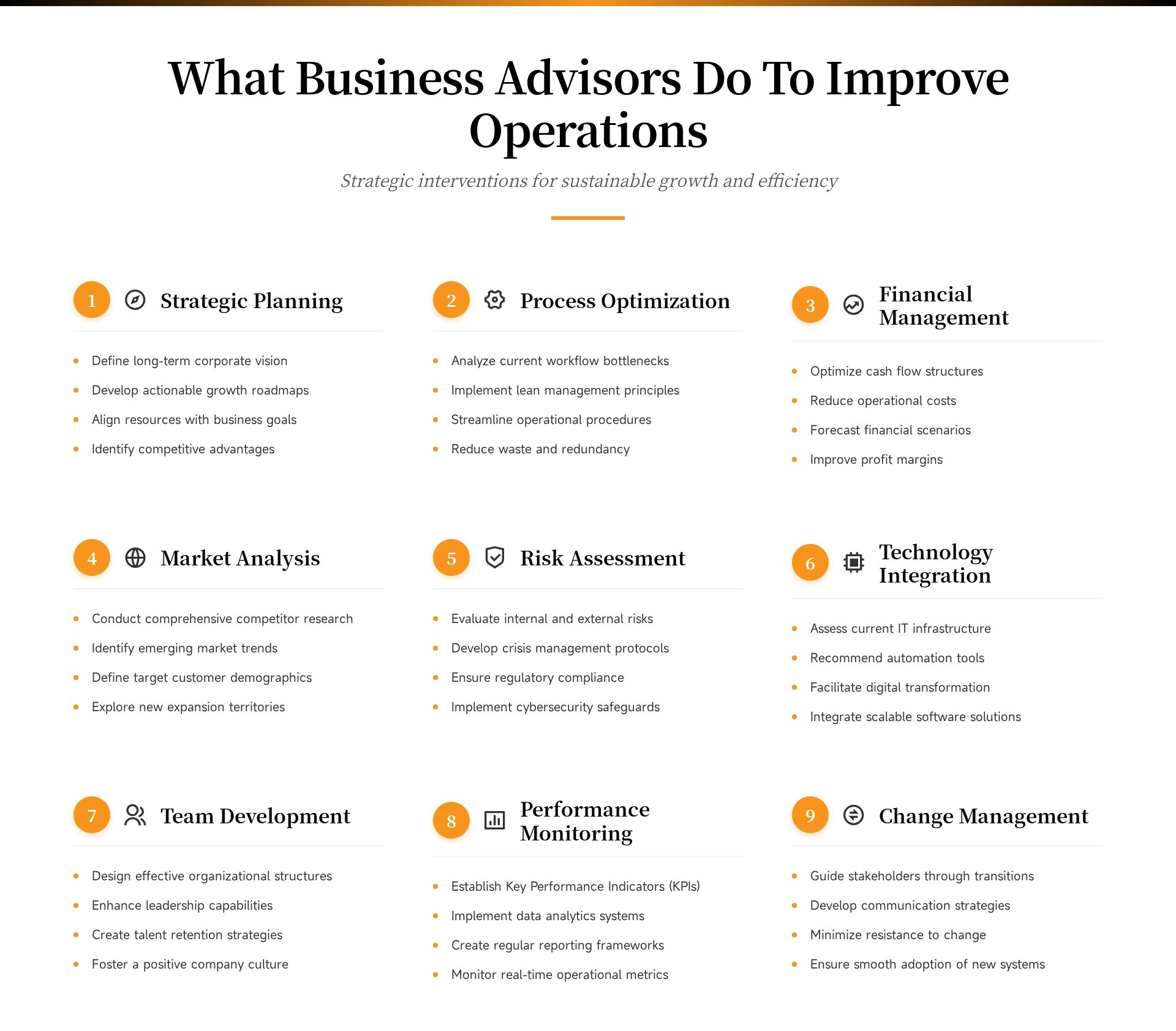
Business advisors take a structured look at your operations, finances and strategy. They uncover what is holding your business back and help you build systems that support sustainable performance. This includes:
1. Strengthening Financial Management and Reporting
Clear financial visibility leads to stronger operations. Advisors help you understand your numbers and use them effectively.
They assist with:
- Reliable and timely reporting
- Cash flow forecasting
- Budget planning
- Reviewing cost structures
- Identifying profit leaks
- Improving financial controls
Accurate financial data supports better, faster decision making. This foundation is essential for operational efficiency.
Learn more in Financial Reporting and Improving Reporting Accuracy.
2. Identifying Inefficiencies in Daily Processes
Even well-run businesses have hidden inefficiencies. Advisors review your internal processes to find weak points.
Common issues include:
- Manual work that could be automated
- Unclear responsibilities or duplicated effort
- Systems that do not communicate properly
- Slow reconciliations
- Inventory or stock issues
- Process bottlenecks between departments
Fixing these areas saves time, reduces errors and improves productivity.
Operational guidance like this aligns with our Business Management Services.
3. Supporting Stronger Strategic Decision Making
Advisors act as a strategic partner who helps you weigh risks, analyse data and choose pathways that support long-term success.
Support includes:
- Reviewing the financial impact of major decisions
- Setting KPIs and measurable goals
- Analysing staffing needs
- Evaluating business structures
- Assessing investment or expansion options
This strategic clarity reflects the leadership approach of Managing Director Mace Turco, whose commercial experience and award-winning advisory background guide our client work.
4. Improving Cash Flow and Supplier Stability
Operational strength relies on predictable cash flow. Advisors help stabilise and improve this core area.
They assist with:
- Reviewing payment and collection cycles
- Improving invoicing systems
- Identifying cash flow gaps
- Building cash flow forecasts
- Implementing better financial controls
Healthy cash flow allows you to pay suppliers on time, retain staff and invest in the future.
For deeper insight, see our Cash Flow Planning Guide.
5. Improving Team Structure and Accountability
Advisors help businesses create clear, productive and accountable team structures.
They support:
- Defining job roles
- Reducing overlap between responsibilities
- Improving communication flow
- Setting KPIs and accountability frameworks
- Strengthening leadership decision making
When expectations are clear, teams move more efficiently and operations improve.
Related insights can be found in Bookkeeping vs Payroll.
6. Enhancing Technology and Software Use
Technology plays a key role in operational efficiency. Advisors help you choose and implement software that streamlines your business.
Technology improvements often achieve:
- Reduced manual work
- Faster reporting
- Better stock or project tracking
- Improved customer service
- More reliable data
7. Reducing Risk and Strengthening Compliance
A proactive advisor helps protect your business by improving compliance and internal controls.
This includes:
- Ensuring systems meet ATO requirements
- Strengthening payroll, BAS and super processes
- Reviewing internal controls
- Preparing for ATO audits
- Identifying industry-specific compliance risks
You can gain more insight from our ATO Audit Guide.
8. Supporting Growth, Expansion and Long-Term Planning
Advisors help you move from reactive management to long-term strategic planning.
Support may include:
- Growth planning
- Business valuations
- Restructuring for operational efficiency
- Expansion analysis
- Succession or exit planning
Explore our specialised advisory services:
9. Building Confidence and Reducing Stress for Owners
One of the most valuable benefits of advisory support is clarity. Owners gain a trusted partner who understands their challenges and helps make decisions with confidence.
This reflects our mission: to build long-term partnerships that help your business thrive.
Ready to Improve Your Operations?
Our advisory team helps businesses gain clarity, improve systems and build long-term stability. If you want confident decision making and stronger operational performance, we are here to help.
Get your free consultation with our business advisors in Perth.
FAQs
What does a business advisor actually do?
They analyse your operations, finances and structure before providing practical strategies to improve efficiency and long-term performance.
How do advisors improve operations?
They streamline processes, strengthen financial visibility, improve team structure, enhance technology usage and support better decision making.
When is the right time to hire a business advisor?
When systems start to feel strained, when cash flow becomes unpredictable, when growth is planned, or when you want clearer, more confident guidance.
How is an advisor different from an accountant?
Accountants focus on compliance. Advisors focus on strategy, growth and operational improvement. At M2 Corporate, we integrate both for stronger outcomes.