How to Prepare a BAS [Step-By-Step Guide]
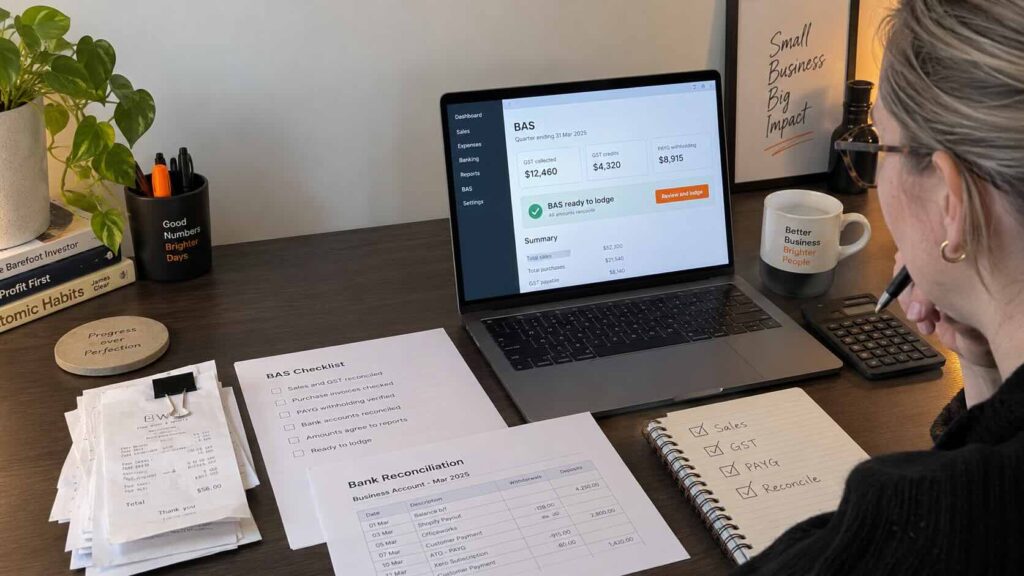
To prepare a BAS, start by bringing your bookkeeping up to date, reconciling your accounts and checking that sales, purchases, GST and payroll transactions have been recorded correctly for the reporting period. You can then review the relevant BAS figures, investigate any discrepancies and complete the sections that apply to your business before lodging.
A Business Activity Statement can cover more than GST. Depending on your registrations and circumstances, it may also include PAYG withholding, PAYG instalments and other tax obligations. Accurate BAS preparation therefore starts with accurate financial records rather than simply copying figures from accounting software.
This guide explains how to prepare a BAS, what records you may need, how GST figures are calculated, what to check before lodging and when professional bookkeeping or BAS support may be useful.
Quick Summary
- Bas preparation starts with complete and up-to-date bookkeeping for the relevant reporting period.
- Bank accounts, credit cards and other relevant accounts should be reconciled before relying on accounting software reports.
- Check sales, purchases, GST treatment, payroll and PAYG figures rather than assuming automatically generated BAS figures are correct.
- Your GST accounting basis can affect when sales and purchases are reported on the BAS.
- The sections you need to complete depend on your business registrations and circumstances, so not every BAS will contain the same obligations.
What Is a BAS?
A Business Activity Statement, or BAS, is a form used to report certain business tax obligations to the Australian Taxation Office (ATO).
A BAS Can Include:
- Goods and services tax (GST)
- Pay as you go (PAYG) withholding
- Payg instalments
- Fringe benefits tax instalments
- Wine equalisation tax
- Luxury car tax.
The sections that appear on your BAS depend on the registrations and obligations attached to your business. A small service business registered for GST and employing staff may therefore have different BAS requirements from another business with no employees or different tax registrations.
Your reporting frequency can also vary. If you are trying to work out when your next statement needs to be submitted, our guide explains when BAS is due and the common reporting cycles.
What Information Do You Need to Prepare a BAS?
The records required will depend on what your business needs to report, but the starting point is generally your bookkeeping for the full BAS period.
You May Need to Review:
- Sales invoices and other income records
- Customer payments
- Supplier bills and expense records
- Receipts and tax invoices
- Bank transactions
- Business credit card transactions
- Gst collected on taxable sales
- Gst credits relating to eligible purchases
- Payroll records
- Payg withholding amounts
- Payg instalment information, where applicable
- Asset purchases and disposals
- Adjustments or corrections relating to previous transactions.
If you use accounting software such as Xero, much of this information can be brought together automatically. However, accounting software can only report what has been entered into it. Missing transactions, duplicate entries or incorrect tax codes can still produce an incorrect BAS.
Businesses setting up their accounting system for the first time can also review our guide to setting up Xero for a small business.
How to Prepare a BAS Step by Step
A structured process makes it easier to check the underlying records before relying on the final BAS report.
Bring Your Bookkeeping up to Date
Record the sales, expenses, payments, receipts and other transactions that belong to the BAS period. Review uncategorised transactions and check that transactions have not been duplicated or omitted.
Reconcile Your Accounts
Compare the transactions in your accounting system with your bank accounts, credit cards and other relevant financial accounts. Investigate unmatched transactions, differences in balances and duplicate entries before moving on.
Review Sales and GST Collected
Check that sales have been recorded in the correct period and review their GST treatment. Separate taxable, GST-free and other sales where relevant rather than assuming every transaction should be treated in the same way.
Check Purchases and GST Credits
Review business purchases and expenses, including the tax code applied to each transaction. Check whether GST was actually included and whether the business is entitled to claim the relevant GST credit.
Review PAYG and Other BAS Obligations
If your BAS includes PAYG withholding, PAYG instalments or other tax obligations, compare those figures with the relevant payroll, accounting and ATO records. Only complete the sections that apply to your business.
Review the BAS and Lodge
Compare the final BAS figures with your accounting reports and investigate amounts that look unusual. Once the figures have been checked, the BAS can be lodged through an available ATO channel or through an appropriately registered tax or BAS agent.
Example of a Completed BAS
The example below shows how the BAS figures might come together for a fictional Australian small business. It is designed to illustrate the relationship between sales, GST credits, PAYG withholding and the final amount payable. An actual BAS may contain different labels depending on the business’s registrations and reporting obligations.
Business Activity Statement
Westside Studio Pty Ltd
Quarterly Reporting Period: 1 July to 30 September
Goods and Services Tax
| G1 | Total sales | $88,000 |
| 1A | Gst on sales | $8,000 |
| 1B | Gst on purchases | $5,000 |
PAYG Withholding
| W1 | Total salary, wages and other payments | $45,000 |
| W2 | Amount withheld from payments shown at W1 | $8,500 |
| 4 | Payg tax withheld | $8,500 |
PAYG Income Tax Instalment
| 5A | Payg income tax instalment | $2,000 |
Example BAS Calculation
$8,000
-$5,000
$3,000
+$8,500
+$2,000
$13,500
This is a fictional example created for illustration only and is not an ATO form. Actual BAS labels, amounts and reporting requirements depend on the business’s registrations and circumstances.
In this example, Westside Studio Pty Ltd collected $8,000 of GST on its taxable sales and had $5,000 of eligible GST credits on purchases. This produces a net GST liability of $3,000.
The business also withheld $8,500 from employee payments and has a $2,000 PAYG income tax instalment for the quarter. With no other credits or obligations included in this simplified example, the illustrative amount payable is $13,500.
The example also shows why the amount payable on a BAS is not simply the difference between GST collected and GST credits. PAYG withholding, PAYG instalments and other applicable obligations can change the final position.
Why Should You Reconcile Your Accounts Before Preparing a BAS?
Reconciliation checks whether the transactions recorded in your accounting system agree with external records such as your bank statement.
For example, your accounting software might show that every supplier expense has been entered, but your bank statement may contain a payment that has not been recorded. If that payment relates to an eligible business purchase, leaving it out could also affect your GST reporting.
The opposite can happen when a transaction has accidentally been entered twice. Your accounting reports may then overstate an expense and potentially the associated GST credit.
Regular account reconciliation helps identify these differences before they flow through to financial reports and activity statements.
How Is GST Calculated on a BAS?
For many GST-registered businesses, two of the key figures are the GST payable on taxable sales and the GST credits available on eligible business purchases.
A Simplified Example Might Look Like This:
- Gst payable on taxable sales: $8,000
- Eligible GST credits on purchases: $5,000
- Net GST amount: $3,000 payable.
This example only shows the GST component. It does not mean that the total amount payable on the BAS would necessarily be $3,000. PAYG withholding, PAYG instalments or other obligations included on the statement can change the final amount.
The GST amount on an ordinary fully taxable sale is commonly one-eleventh of the GST-inclusive price. However, not every sale is taxable and not every business expense gives rise to a full GST credit. The GST treatment needs to reflect the actual transaction.
What Is the Difference Between Cash and Non-Cash GST Accounting?
Your GST accounting basis affects when sales and purchases are included in your BAS.
Cash Basis
Under cash-basis GST accounting, GST is generally attributed as payment is received from customers or made to suppliers.
For example, if an invoice is issued in June but the customer does not pay until July, the timing of the GST reporting may fall into the later period when accounting on a cash basis.
Non-Cash Basis
Under a non-cash basis, sometimes referred to as accrual GST accounting, the timing can be based on when an invoice is issued or payment occurs, depending on the transaction and applicable rules.
This means a business may sometimes report GST before the related customer invoice has actually been paid.
Check the accounting basis registered for your business rather than changing the BAS period simply to match when cash moved through the bank account. The ATO provides further guidance on choosing a GST accounting method.
BAS Preparation Checklist
Before lodging, use this BAS preparation checklist to make sure the underlying records have been reviewed rather than relying solely on an automatically generated BAS report.
| Check | What to review | Why it matters |
|---|---|---|
| Bookkeeping complete | Sales, purchases, payments and receipts for the full reporting period | Missing transactions can change BAS figures |
| Bank accounts reconciled | Accounting balances against bank statements | Helps identify missing and duplicate entries |
| Credit cards reconciled | Business credit card purchases and payments | Expenses can otherwise be missed or duplicated |
| Sales reviewed | Sales period, GST treatment and unusual transactions | Incorrect sales coding can affect GST payable |
| Purchases reviewed | Expenses, GST codes and supporting records | Helps support the GST credits being reported |
| Payroll checked | Payroll records and PAYG withholding | Payg figures should agree with the underlying payroll records |
| Accounting basis confirmed | Cash or non-cash GST reporting | Determines when relevant transactions are reported |
| Final BAS reviewed | Bas figures compared with accounting reports and prior periods | Unexpected differences can be investigated before lodgement |
What Should You Check on Sales Before Lodging a BAS?
Do not assume that every dollar of revenue shown in your profit and loss report attracts GST in exactly the same way.
When Reviewing Sales, Consider Whether:
- All sales for the relevant period have been recorded
- Sales have been included in the correct BAS period
- The correct GST code has been applied
- Gst-Free or other non-taxable transactions have been treated correctly
- Credit notes and refunds have been entered correctly
- Large or unusual transactions need additional checking.
This review is particularly useful if the GST reported appears significantly different from your normal trading pattern.
What Should You Check on Business Expenses?
Business expenses also need to be reviewed before GST credits are included in the BAS.
A payment appearing in a business bank account does not automatically mean the business can claim GST on the full amount.
Check:
- Whether GST was included in the purchase
- Whether the supplier and transaction have been recorded correctly
- Whether the expense is business-related
- Whether any private component needs to be accounted for
- Whether the GST code in the accounting system is correct
- Whether supporting documentation is available where required.
Examples that commonly require additional attention include bank fees, wages, loan transactions, owner drawings, some insurance transactions and purchases with a private-use component. Different transactions can have different GST treatment, so the accounting code should reflect the actual nature of the expense.
How Do Payroll and PAYG Affect a BAS?
If your business employs staff, PAYG withholding may form part of your activity statement.
Before completing the BAS, compare the payroll figures in your accounting or payroll system with the amounts being reported. Check that pay runs for the full period have been processed and that corrections or adjustments have been reflected correctly.
Payroll, GST and bookkeeping are related but separate parts of the accounting process. Our guide to bookkeeping vs payroll explains the distinction in more detail.
Can You Prepare and Lodge Your Own BAS?
Yes. A business owner can prepare and lodge their own BAS.
For a business with relatively straightforward transactions and well-maintained records, this may be manageable. The key issue is whether the information being reported is accurate, not simply whether the form can be completed.
Preparing Your Own BAS Can Become Harder When the Business Has:
- A high volume of transactions
- Multiple bank accounts or credit cards
- Employees and payroll obligations
- Mixed GST treatments
- Asset purchases or disposals
- Private and business expenditure that needs to be separated
- Unreconciled historical transactions
- More complex bookkeeping or tax requirements.
Keeping accurate records throughout the quarter or month can reduce the work required when BAS time arrives.
Can a Bookkeeper Prepare Your BAS?
A bookkeeper can assist with the financial records that support BAS preparation, including recording transactions, reconciling accounts and maintaining accounting systems.
However, providing BAS services for a fee is regulated in Australia. Where the work constitutes a BAS service, the person or entity generally needs to be registered with the Tax Practitioners Board unless an exemption applies.
The scope of a BAS service can include determining or advising a client about obligations under a BAS provision, or representing a client in dealings with the ATO in relation to those obligations.
Our guide explains in more detail whether a bookkeeper can lodge a BAS.
What Is a BAS Agent?
A BAS agent is a tax practitioner registered with the Tax Practitioners Board to provide BAS services within the scope of their registration.
Registration requirements include relevant qualifications and experience, along with other professional requirements set by the Tax Practitioners Board.
If you are paying someone specifically to provide BAS services, you can check their registration on the Tax Practitioners Board’s public register. You can also read our explanation of what a BAS agent is.
What Happens if You Make a Mistake on a BAS?
A BAS error does not necessarily mean the original statement must always be handled in the same way. The appropriate correction depends on the type of error and the circumstances.
The ATO allows some GST errors from an earlier tax period to be corrected on a later BAS where the relevant conditions are satisfied. Other errors may need to be dealt with by revising the earlier statement or using another correction process.
For example, the ATO distinguishes between credit errors, where too much GST was reported or paid, and debit errors, where too little GST was reported or paid. Different conditions can apply when correcting these errors.
If You Identify an Error, First Establish:
- What caused the mistake
- Which BAS period is affected
- Whether the underlying bookkeeping also needs to be corrected
- Whether the error qualifies to be corrected on a later BAS
- Whether the original BAS needs to be revised instead.
The ATO provides current guidance on correcting GST errors. Where the correct treatment is unclear, consider obtaining professional assistance before changing previously lodged figures.
How Can Better Bookkeeping Make BAS Preparation Easier?
The easiest time to prepare for your next BAS is throughout the reporting period, not on the day it is due.
Regular bookkeeping allows transactions to be entered, coded and reconciled while the supporting documents and business context are still readily available.
A Regular Bookkeeping Process May Include:
- Processing transactions throughout the month
- Matching customer payments to invoices
- Allocating supplier payments correctly
- Reconciling bank and credit card accounts
- Reviewing accounts receivable and payable
- Maintaining payroll records
- Checking GST coding
- Reviewing reports before the end of the BAS period.
This does more than support BAS preparation. Current financial records can also give a business owner a clearer view of cash flow, outstanding debts, expenses and financial performance.
M2 Corporate’s Bookkeeping services support businesses with ongoing transaction processing, reconciliations, financial records and BAS and IAS readiness. The level of support required will depend on the business, its systems and the complexity of its financial records.
When Should You Get Help with BAS Preparation?
Professional support may be worth considering when you are unsure whether the underlying records are correct or the BAS involves transactions you do not know how to treat.
Common Situations Include:
- Your bookkeeping has fallen several months behind
- Bank or credit card accounts will not reconcile
- You are unsure which GST codes should apply
- Your BAS figures differ significantly from your accounting reports
- You have recently registered for GST
- You have started employing staff
- You have significant asset purchases or disposals
- You have discovered errors in a previously lodged BAS
- Your business has become more complex as it has grown.
BAS is one part of the wider accounting and tax obligations of running a business. Our guide to tax compliance for Australian businesses covers several other areas business owners may need to manage.
FAQs
What Do I Need to Prepare My BAS?
You generally need complete financial records for the reporting period, including sales, purchases, bank transactions, GST information and any relevant payroll or PAYG records. The exact records required depend on the obligations included on your BAS.
How Do I Prepare a BAS for the First Time?
Start by confirming the period covered by the statement and the obligations shown on it. Bring your bookkeeping up to date, reconcile the relevant accounts, review GST coding and payroll records, then compare the BAS figures with your accounting reports before lodging.
How Do I Calculate BAS?
There is no single calculation for the whole BAS because it can contain several tax obligations. For GST, the net position generally takes into account GST payable on taxable sales and eligible GST credits on business purchases. PAYG and other obligations can then affect the overall BAS amount.
What Documents Do I Need for a BAS?
Documents may include sales invoices, supplier invoices, receipts, bank statements, credit card records, payroll reports and other records supporting the transactions reported for the period. What you need depends on the nature of your business and the BAS labels you must complete.
Do I Need to Reconcile My Bank Account Before BAS?
Reconciliation is a useful part of BAS preparation because it helps identify missing, duplicated and unmatched transactions before you rely on your accounting reports. Business.gov.au also recommends reconciling BAS figures with your records before lodgement.
Can I Do My BAS Myself?
Yes. Business owners can prepare and lodge their own BAS. Whether this is practical depends on the quality of the bookkeeping and the complexity of the transactions and obligations involved.
Can a Bookkeeper Lodge My BAS?
A bookkeeper may be able to provide BAS services if they are appropriately registered or the work falls within an applicable exemption. BAS services supplied for a fee are regulated by the Tax Practitioners Board.
Does BAS Include Payroll?
A BAS can include PAYG withholding relating to payments such as employee wages. The exact sections appearing on the BAS depend on the business’s registrations and obligations.
Does Every Business Need to Lodge a BAS?
No. Whether a business needs to lodge activity statements depends on its tax registrations and obligations. For example, GST-registered businesses generally have GST reporting obligations, while other registrations can also create activity statement requirements.
How Often Do Businesses Lodge BAS?
The reporting cycle depends on the business’s circumstances and ATO requirements. BAS reporting may be monthly, quarterly or, in some circumstances, annually. Check the reporting period and due date shown for your business rather than assuming the same cycle applies to every business.
What Happens if My BAS Figures Look Wrong?
Do not lodge solely because the figures came from accounting software. Recheck reconciliations, transaction dates, GST codes, sales, purchases and payroll records. If the difference cannot be explained, professional assistance may help identify the underlying issue.
Can I Correct a BAS After It Has Been Lodged?
Yes, BAS errors can be corrected, but the appropriate process depends on the error. Some GST errors may be corrected on a later BAS if ATO conditions are met, while other errors may require revision of the original statement.
Get Your Bookkeeping Ready for BAS
A smoother BAS process starts well before the lodgement deadline. Keeping transactions current, accounts reconciled and GST coding accurate throughout the reporting period makes it easier to review the figures and identify problems before they are reported.
M2 Corporate works with businesses in Perth and across Australia through Accounting & Tax and Bookkeeping services. Support can range from maintaining day-to-day financial records through to helping businesses manage their broader accounting and reporting requirements.
If your accounts are behind, your BAS figures are not reconciling or you would like support maintaining your bookkeeping throughout the year, speak with M2 Corporate about the level of support that may be appropriate for your business.
This information is general only and does not take into account your objectives, financial situation or needs. Tax and BAS requirements depend on your circumstances and may change over time.