How to Register a Pty Ltd Company in Australia
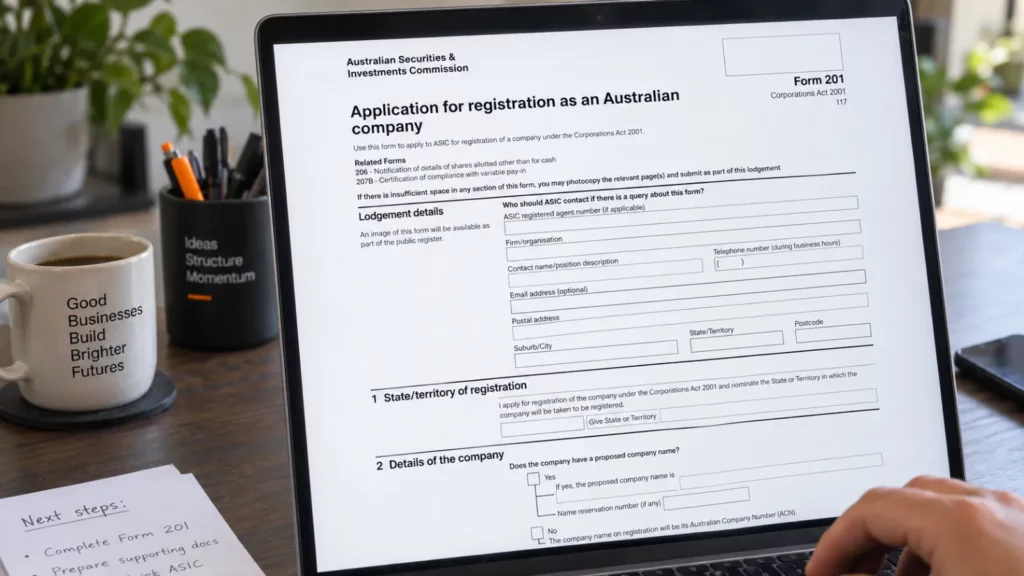
To register a Pty Ltd company in Australia, you need to appoint an eligible director, decide who will own the shares, provide company addresses, obtain the necessary consents and lodge an application with the Australian Securities and Investments Commission (ASIC). Most standard applications can be completed through the Australian Government Business Registration Service.
Once registered, the company receives its Australian Company Number (ACN) and can apply for the tax registrations it needs. This guide explains the requirements, the registration process, the fees applying from 1 July 2026 and the responsibilities that continue after incorporation.
Quick Summary
- A standard Pty Ltd company can have one director and one shareholder, who may be the same person. At least one director must ordinarily live in Australia.
- Directors must apply for their own director identification number (director ID) before appointment. Written consents and details of the company’s shareholders, shares and addresses are also required.
- From 1 July 2026, ASIC charges $636 to register a standard proprietary company with share capital. The standard annual review fee is $342.
- Company registration does not automatically provide an ABN, tax file number (TFN), GST registration or business name registration. These are separate registrations, although some can be requested through the same government service.
- Limited liability generally limits a shareholder’s exposure in that capacity, but it does not remove directors’ legal duties or every form of personal liability.
What Is a Pty Ltd Company?
A proprietary limited company, commonly called a Pty Ltd company, Is a privately held company registered under the Corporations Act 2001. For a standard company limited by shares, the business becomes a legal entity separate from the people who own and manage it.
The company can enter into contracts, own assets, employ staff and incur debts in its own name.
There are two main roles within a company:
- Shareholders: The people or entities that own shares in the company. Their shares represent an ownership interest and may carry voting, dividend and other rights.
- Directors: The people responsible for managing or overseeing the company’s operations and meeting its legal obligations.
One person can be both a director and shareholder. This is common in smaller owner-managed businesses.
Shareholders of a company limited by shares are generally not personally responsible for company debts merely because they hold shares. However, they may still owe any unpaid amount on their shares, and directors can face personal liability in certain circumstances.
A company structure also brings administration, tax and reporting obligations that may not apply to a sole trader.
Whether a company is appropriate depends on the business’s ownership, risk profile, income, plans for investment and ongoing costs. M2 Corporate discusses these considerations through its Business Advisory support for starting a business.
What Are the Requirements to Register a Pty Ltd Company in Australia?
Before submitting an ASIC company registration, you need eligible officeholders, at least one shareholder, a valid share structure, Australian business addresses and rules for governing the company.
1. At Least One Eligible Director
A standard proprietary company needs at least one director who ordinarily resides in Australia.
Every director must:
- Be an individual aged 18 or older.
- Not be disqualified from managing companies, unless legally permitted.
- Provide written consent to act as a director.
- Apply for a director identification number before appointment.
A company secretary is optional for a proprietary company. If a secretary is appointed, at least one must ordinarily reside in Australia.
Different director requirements may apply to a proprietary company with crowd-sourced funding shareholders.
2. A Director Identification Number
Each proposed director must apply for a Director ID before appointment.
A director ID is a unique identifier issued by Australian Business Registry Services (ABRS). It is designed to help verify the identity of people appointed as company directors.
Applying directly through ABRS is free. Each person must complete their own application and identity verification. An accountant or company registration provider can explain the application process, but cannot apply for the director ID on the person’s behalf.
Most online applicants use a Digital ID, such as myID, and provide information to verify their identity. Alternative application methods are available for people who cannot use the online process.
See the ABRS director ID requirements for eligibility and timing.
3. At Least One Shareholder and a Share Structure
Every company must have at least one shareholder, also called a member.
A standard proprietary company generally cannot have more than 50 non-employee shareholders, subject to specific rules and exceptions, including some crowd-sourced funding arrangements.
Before registering, decide:
- Who will own shares in the company.
- How many shares will be issued to each shareholder.
- Which class of shares will be issued, such as ordinary shares.
- What amount is payable for the shares and whether any amount remains unpaid.
- Whether additional ownership arrangements, such as a shareholders agreement, need to be documented.
The company must obtain written consent from its proposed members confirming the shares they agree to take.
Share allocation can affect voting rights, control and future changes in ownership, so it is worth resolving before registration.
4. A Company Name
You can register an available company name ending in its legal status, such as Example Services Pty Ltd.
Alternatively, ASIC can register the company using its ACN as the name.
Before selecting a name, check whether it is available through ASIC. Certain words and expressions may be restricted or require approval.
Company name registration is different from business name registration and trade mark protection.
For example, if Example Services Pty Ltd Intends to trade as Example Digital, it will generally need to register Example Digital as a business name.
Registering a company or business name does not, by itself, give exclusive trade mark rights. A separate trade mark search may therefore be relevant.
5. A Registered Office and Principal Place of Business
ASIC requires two addresses when a company is registered:
- Registered office: A physical street address in Australia where official notices and correspondence can be received.
- Principal place of business: The main physical address where the company conducts its business activities.
Neither address can be a PO Box.
The registered office does not have to be the location where the company conducts its day-to-day operations. For example, a company may use an accountant’s office as its registered office.
If the company does not occupy or own the registered office, it must retain the occupier’s written consent to use the address.
Company details, including certain addresses and officeholder information, can be available through ASIC’s register. Applicants using a home address should understand the public disclosure implications before lodging.
6. Company Rules or a Constitution
A company needs rules explaining how decisions are made and how it is managed.
Depending on its circumstances, the company may:
- Use the replaceable rules in the Corporations Act 2001.
- Adopt its own company constitution.
- Use a combination of replaceable rules and a constitution.
Replaceable rules are standard provisions governing matters such as director appointments, meetings and share-related decisions.
Special statutory provisions apply to a proprietary company where the same person is its sole director and sole shareholder.
A constitution can be useful when a company has several owners or plans to introduce investors, but a separately drafted constitution is not mandatory for every Pty Ltd company.
How Do You Register a Pty Ltd Company Step by Step?
Most standard Pty Ltd registrations follow six stages, from deciding on ownership through to ASIC approval and tax setup.
You can use the Australian Government Business Registration Service (BRS) or engage a provider to assist with the process.
Confirm the Company Structure
Decide who will be directors and shareholders, how ownership will be split and whether a company is suitable for the proposed business. Agree on the share classes and internal governance rules before lodging.
Choose the Name and Addresses
Check the company name with ASIC and consider a separate trade mark search. Confirm the registered office, principal place of business and written permission to use any address owned by another party.
Arrange Director Ids and Consents
Each proposed director applies personally for their director ID before appointment. Collect signed consents from officeholders and written agreements from the initial shareholders.
Finalise Shares and Company Rules
Record the number, class, issue price and holders of the shares. Decide whether the company will use replaceable rules, a constitution or a combination of both.
Lodge and Pay Through the BRS
Submit the details through the Australian Government Business Registration Service or use a registration provider. The ASIC fee for a standard proprietary company with share capital is $636 from 1 July 2026.
Receive Confirmation and Set up Records
After ASIC registers the company, retain its Australian Company Number (ACN) and certificate of registration. Establish the members register and other records, then complete the relevant business and tax registrations.
ASIC processes the company registration. Once it is approved, the BRS sends a confirmation that includes the ACN and certificate of registration.
ASIC separately provides a corporate key for managing certain company details. Some circumstances require a different application process rather than the standard online BRS form.
What Documents Should You Keep After Company Registration?
ASIC provides evidence that the company is registered, but company formation involves more than a certificate.
The company must also maintain its own records, and some supporting documents are prepared by the founders or their registration provider rather than issued by ASIC.
- Certificate of registration and ACN: Issued following registration and used to identify the legal entity.
- Constitution, if adopted: The rules chosen to govern the company.
- Signed officeholder and member consents: Evidence that directors, secretaries (if any) and shareholders agreed to their roles or shareholdings.
- Register of members: Records the shareholders and their interests in the company.
- Share issue records: Records the number, class, price and ownership of issued shares. Share certificates may also be prepared.
- Company resolutions and minutes: Documents relevant decisions, including initial company arrangements.
Keep formation documents in a location that directors can access. Other records may be needed depending on the ownership, governance arrangements and activities of the business.
How Much Does It Cost to Register a Pty Ltd Company in 2026?
From 1 July 2026, The government fee to register a standard proprietary company with share capital is $636.
This is separate from professional fees, optional business name registration and the company’s annual ASIC review fee.
| Cost item | Government fee from 1 July 2026 | When it applies |
|---|---|---|
| Standard Pty Ltd company registration | $636 | One-Off ASIC registration fee |
| ASIC annual review | $342 | Each year for a standard proprietary company |
| Optional business name registration | $47 For one year or $108 for three years | If the business trades under a different name |
| Abn and director ID applications | Free when applying through official government services | Separate registrations; eligibility and application requirements apply |
Other establishment costs Depend on whether you require assistance with a constitution, shareholder arrangements, accounting software, registered office services or taxation registrations.
ASIC fees are not subject to GST and are generally indexed each July. The figures above reflect the government’s published 2026 fee changes.
What Do You Need to Do After Registering a Pty Ltd Company?
Once the company exists, you need to complete the tax and operational registrations relevant to its activities.
Registration with ASIC alone does not mean the company is ready to meet every business or employment obligation.
Apply for the Company’s ABN and TFN
An Acn is a nine-digit identifier issued by ASIC when a company is registered.
An Abn is an 11-digit number used for business and tax purposes, while a TFN identifies the company for income tax.
A registered company generally applies for its own ABN and TFN.
The company cannot simply continue using a director’s personal TFN or an earlier sole trader ABN. Eligible tax registrations can be requested together through government registration services.
Register for GST Where Required
A business generally needs to register for Goods and services tax (GST) if its GST turnover reaches or is expected to reach $75,000, subject to the ATO’s turnover calculation rules.
Registration is generally required within 21 days of becoming required to register. Some activities, including taxi and ride-sharing services, have separate rules regardless of turnover.
Businesses below the compulsory threshold may choose to register voluntarily.
Registering a company does not automatically register it for GST. See the ATO’s GST registration guidance for the current and projected turnover tests.
Set up Payroll and Employment Registrations if Hiring
If the company makes payments that require tax withholding, including employee wages, it generally needs PAYG withholding registration.
Employers will also usually need processes for Single Touch Payroll (STP), workers compensation and other relevant employment requirements.
Payday Super has applied from 1 July 2026. Employers generally need to pay superannuation guarantee contributions on payday so they reach employees’ super funds within seven business days, with extended periods in some situations.
The standard super guarantee rate is 12% of qualifying earnings under the new rules. The Fair Work Ombudsman explains the 2026 changes.
Separate Company Finances and Check Operating Requirements
Set up banking and bookkeeping in the company’s legal name, establish appropriate invoicing procedures and retain invoices, receipts and contracts.
Distinguishing company transactions from personal spending helps maintain reliable records and supports tax reporting.
M2 Corporate can assist with accounting software setup where relevant.
Some businesses also need state, territory or local licences, professional registrations, insurance or employment-related approvals.
The Australian Business Licence and Information Service can help identify requirements by activity and location.
How Is a Pty Ltd Company Taxed in Australia?
A registered company is generally taxed separately from its shareholders.
For ordinary Australian companies, the standard company income tax rate is 30%, While companies that meet the base rate entity tests may qualify for the 25% rate.
Broadly, the lower rate depends on:
- Aggregated turnover of less than $50 million.
- No more than 80% of assessable income being base rate entity passive income, such as certain interest, rent and dividends.
These rules are assessed for the relevant income year. See business.gov.au’s company tax guidance.
The company tax rate applies to taxable income, not total sales.
Money paid to shareholders or directors through salaries, dividends or other arrangements can have further tax and reporting consequences.
The structure does not automatically produce a lower overall tax outcome, and specific rules such as the personal services income provisions may be relevant for some service businesses.
What Ongoing Obligations Does a Pty Ltd Company Have?
Registration is a one-off process, but company compliance is ongoing. ASIC, the ATO and other regulators impose different requirements depending on the business and its operations.
ASIC Annual Company Review
ASIC generally issues an annual statement around the anniversary of the company’s registration.
The company must check its details, pay the applicable review fee by the due date and pass a solvency resolution within the required timeframe, subject to any relevant exception.
A solvency resolution records the directors’ view about whether the company can pay its debts when they become due.
Keeping Company Information up to Date
Companies must keep their ASIC information accurate.
Changes to directors, company addresses, shares and other recorded information may need to be reported to ASIC.
Many changes must be notified within 28 days, although deadlines depend on the particular change.
Maintaining Financial and Company Records
Companies need records that accurately explain their transactions and financial position.
These may include:
- Invoices and receipts.
- Bank statements and reconciliations.
- Shareholder registers and share issue records.
- Relevant company meeting minutes and resolutions.
- Financial statements and tax records.
- Payroll and superannuation records, where relevant.
Under the Corporations Act, company financial records generally need to be retained for at least seven years.
Tax Returns and Activity Statements
A company generally has its own annual income tax return obligations.
Depending on its registrations and activities, it may also need to lodge BAS or IAS reports covering GST, PAYG withholding or other tax amounts.
Companies that employ staff need to meet applicable payroll, STP and superannuation requirements.
Director Duties and Financial Reporting
Directors have continuing duties under the Corporations Act, including exercising care and diligence, acting in the company’s interests and remaining informed about its financial position.
Some proprietary companies must lodge financial reports with ASIC, depending on their size, shareholders or other circumstances. Not every small proprietary company has this lodgement obligation.
For practical detail, ASIC publishes guidance on annual company reviews and company record keeping.
Businesses may also use M2 Corporate’s Accounting & Tax services to discuss ongoing reporting requirements.
Does a Pty Ltd Company Protect Your Personal Assets?
A Pty Ltd company creates a separation between the company and its shareholders, which can limit a shareholder’s exposure to company debts in their capacity as a shareholder.
That protection is not absolute.
A director may face personal consequences for breaching legal duties, including certain insolvent trading obligations.
An owner may also be personally responsible for a debt covered by a personal guarantee. Specific tax, employment and other statutory obligations may create further liabilities.
Asset protection depends on more than registering a company.
For related background, see our explanation of asset protection considerations.
What Are Common Mistakes When Setting up a Pty Ltd Company?
The most avoidable issues usually involve ownership decisions and obligations that were not settled before the ASIC form was lodged.
Choosing Shareholdings Without Discussing Control
A 50/50 ownership split, for example, can create different decision-making issues from a 60/40 split, depending on the company rules and shareholders agreement.
Shareholder voting rights, future ownership changes and the treatment of departing owners may warrant consideration before shares are issued.
Confusing Company Registration with Brand Protection
Registering a company name with ASIC does not automatically give exclusive rights to use that name as a trade mark.
Business owners may need to check registered trade marks and consider whether their own trade mark application is appropriate.
Using an Unsuitable Registered Office
The registered office must be a physical Australian address.
It cannot be a PO Box, and written consent is required when the company does not occupy or own the address.
Assuming Tax Registrations Are Automatic
An ACN, ABN, TFN, GST registration and PAYG withholding registration serve different purposes.
Not every registration applies to every company, and forming a company does not automatically satisfy all tax obligations.
Continuing to Trade as a Sole Trader Without Updating Arrangements
Moving to a company creates a separate legal entity. Contracts, assets, banking and registrations may need to be transferred or changed appropriately.
The tax and legal consequences of transferring an existing business depend on its circumstances.
Ignoring Continuing Company Costs
ASIC annual reviews, record keeping, bookkeeping, tax reporting and, where relevant, payroll all need ongoing attention.
These costs form part of evaluating whether a company structure is appropriate, rather than being considered only after registration.
Example: Registering a Pty Ltd Company for a Small Business
The following is a fictional example for illustration only.
Jamie and Morgan are starting a design studio in Perth. They decide to register Glenbrook Design Pty Ltd, With both individuals appointed as directors.
They each apply for their own director ID and sign the required consents.
Establishing Share Ownership
They decide the company will issue 100 ordinary shares at $1 per share, with Jamie taking 60 shares and Morgan taking 40.
That is their proposed ownership arrangement, not an ASIC requirement for every company.
They agree on the registered office and principal place of business, choose how the company will be governed and submit the registration application.
Completing Tax and Business Registrations
Once ASIC registers the company and issues an ACN, they apply for the company’s ABN and TFN.
They plan to market the business as Glenbrook Studio, So they also consider registering that separate business name and checking relevant trade mark rights.
They expect GST turnover of $95,000 in their first year, so GST registration is likely to be required.
Preparing to Operate
Jamie and Morgan establish company banking and accounting records.
If they later employ someone, they will also need to consider PAYG withholding, STP and superannuation.
The company will have its own accounting records and will need to complete its annual ASIC review.
This example shows why decisions about shares, governance and tax registrations sit alongside the company application itself.
Frequently Asked Questions About Pty Ltd Registration
Can I Register a Pty Ltd Company Myself?
Yes. Many standard companies can be registered directly through the Australian Government Business Registration Service. Using an accountant or company registration provider is optional, although professional input may be useful where there are several owners, different share classes or specific tax and governance questions.
Can I Register a Company with Only One Director and Shareholder?
Yes. A standard proprietary company can have one person who acts as both director and shareholder. That director must ordinarily reside in Australia and meet the other eligibility requirements. Special provisions apply when the sole director is also the sole shareholder.
Can Someone Who Lives Overseas Own an Australian Pty Ltd Company?
In many circumstances, an overseas resident can hold shares in an Australian proprietary company. However, the company still needs at least one director who ordinarily resides in Australia. Foreign investment, tax, identification and immigration requirements may also be relevant, depending on the circumstances.
Do I Need an ABN Before Registering a Pty Ltd Company?
No. ASIC issues the ACN when the company is incorporated, and the company can then apply for its own ABN. Integrated registration services allow eligible applicants to request company and tax registrations as part of the broader setup process.
Do I Need a Company Constitution?
Not always. Many companies can use the replaceable rules under the Corporations Act, with special provisions for a sole-director, sole-shareholder company. A constitution may be useful where owners need more specific governance rules, but its suitability depends on the company’s circumstances.
How Long Does It Take to Register a Pty Ltd Company?
Processing time depends on the accuracy and completeness of the application, name or identity checks and whether ASIC needs to review the application manually. Online registration may be quicker for a straightforward application, but there is no single approval timeframe that applies to every company.
Is a Pty Ltd Company Automatically Registered for GST?
No. GST registration is separate from company incorporation. Most businesses need to register when they meet the $75,000 GST turnover threshold, while some activities have different rules. A business may also be able to register voluntarily below the threshold.
Can I Change from a Sole Trader to a Pty Ltd Company?
Yes, but forming a company creates a new legal entity rather than simply changing the name of an existing sole trader business. Assets, contracts, registrations and tax arrangements may need to be reviewed. Legal and tax implications can vary with the business’s circumstances.
Company Registration Support from M2 Corporate
Registering a Pty Ltd company involves more than choosing a name and paying the ASIC fee. Directors and founders also need to understand their ownership records, tax registrations and continuing responsibilities.
M2 Corporate is a boutique Perth accounting and advisory firm supporting business owners with company establishment, compliance and ongoing financial reporting.
Our company registration services in Perth can help you discuss the documents and registrations involved in establishing a company.
This information is general only and does not take into account your objectives, financial situation or needs. Requirements and tax outcomes depend on individual circumstances. Fees and rules are stated as at 16 October 2026 and may change.